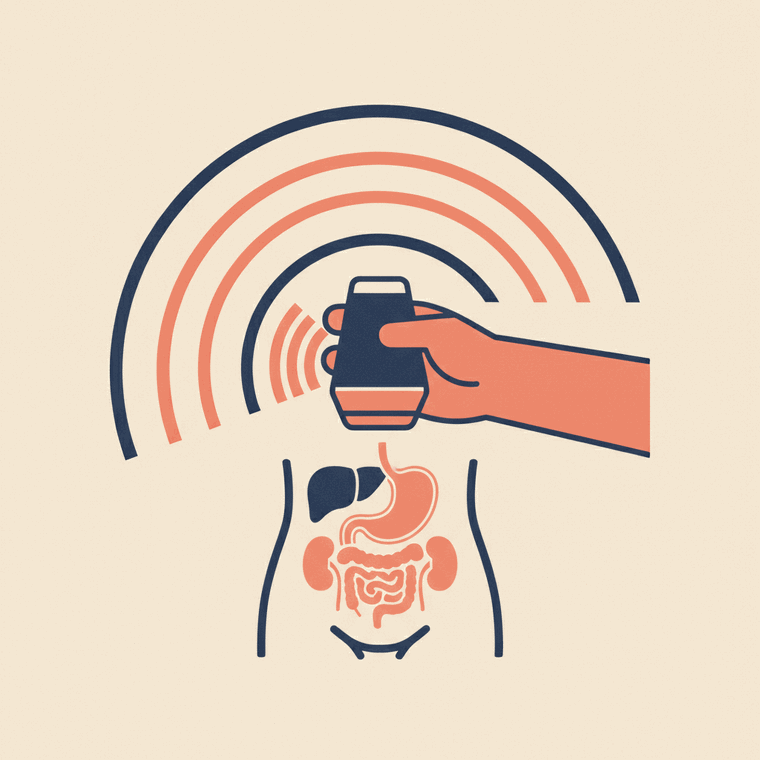
An abdominal ultrasound uses sound waves — no radiation — to examine the liver, gallbladder and bile ducts, kidneys, pancreas, spleen and the aorta. It's often the first test for abdominal pain, suspected gallstones, liver or kidney problems, and to check the main artery (aorta). You'll usually need to fast for several hours beforehand, which empties the gallbladder and reduces bowel gas for a clearer view. The scan is painless and takes about 20–30 minutes.
Key takeaways
- It examines the liver, gallbladder, kidneys, pancreas, spleen and aorta — no radiation.
- It's often the first test for abdominal pain or suspected gallstones.
- You usually fast for several hours so the gallbladder is full and bowel gas is reduced.
- It's painless and takes about 20–30 minutes.
When something’s wrong in the belly, an ultrasound is often the first scan a doctor reaches for — it’s safe, quick, radiation-free, and very good at seeing the abdominal organs.
What it shows
An abdominal ultrasound gives a clear, real-time view of the soft organs of the upper abdomen:[1]
- Liver — its size, texture and any masses (for example, in liver disease or to check a spot found on another scan)
- Gallbladder and bile ducts — especially gallstones, a very common finding
- Kidneys — size, blockage, and cysts
- Pancreas and spleen
- The aorta — the body’s main artery, checked for an aneurysm
It’s commonly used for unexplained abdominal pain, abnormal liver or kidney blood tests, or to follow up something seen on another scan.[1]
Why you fast beforehand
For most abdominal ultrasounds you’ll be asked to fast for several hours (often around 6 hours; less for children).[1] There are two reasons: fasting keeps the gallbladder full (an empty gallbladder is hard to assess), and it reduces bowel gas, which would otherwise block the sound waves. You can usually still sip water — follow your clinic’s instructions.
What to expect
You lie on your back while a sonographer applies gel and moves the probe over your abdomen, sometimes asking you to breathe in and hold to bring an organ into view.[1] It’s painless (pressure over a sore spot may be briefly uncomfortable) and takes about 20–30 minutes. The gel wipes off, and you can eat and resume normal activities straight away.
Its limits
Sound can’t pass through gas or bone, so parts of the gas-filled bowel and anything hidden behind it can be hard to see, and imaging is harder in larger patients.[1] If ultrasound can’t answer the question, a CT or MRI may follow.
Frequently asked questions
Can an abdominal ultrasound detect gallstones?
Yes — ultrasound is very good at finding gallstones, which is one of the most common reasons for the scan.[1]
Do I have to fast, and can I drink water?
Usually yes to fasting (often about 6 hours). You can generally sip water, but follow your clinic’s specific instructions.[1]
Why an ultrasound and not a CT for my abdomen?
Ultrasound is safe, radiation-free and excellent for the liver, gallbladder and kidneys, so it’s often first. CT gives a more complete cross-section and is used when ultrasound can’t answer the question or for trauma and cancer staging.[1]
Sources
- RadiologyInfo.org (RSNA & ACR) — General Ultrasound — www.radiologyinfo.org/en/info/genus
- RANZCR / InsideRadiology — Ultrasound (Coombs) — www.insideradiology.com.au/ultrasound-hp/