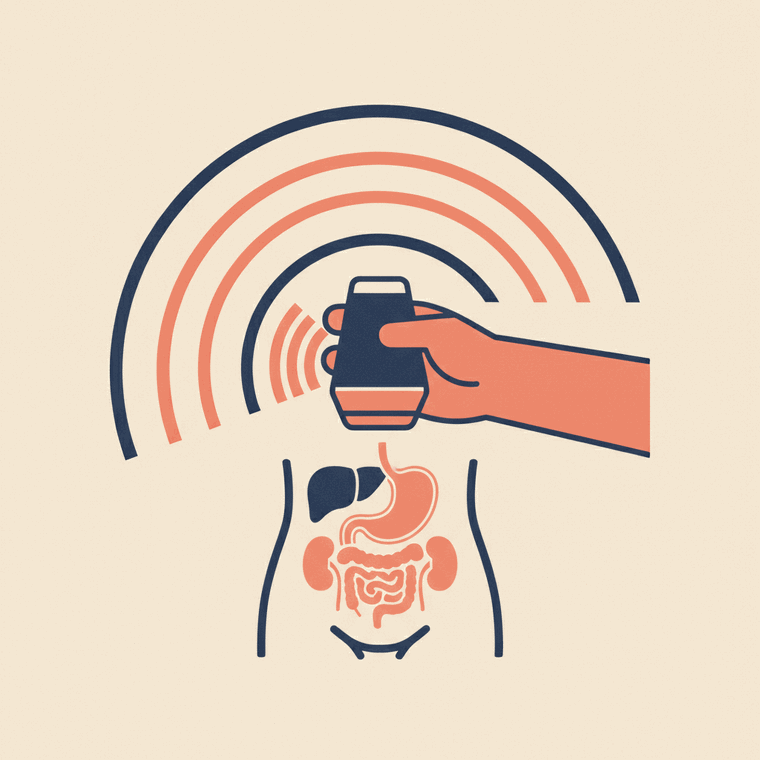
A transvaginal ultrasound uses a slim, lubricated probe gently placed inside the vagina to get a close, clear view of the uterus, ovaries and early pregnancy — much clearer than scanning through the abdomen. It uses no radiation (sound waves), takes about 15–30 minutes, and needs an empty bladder (the opposite of an abdominal scan). It's your choice — you can decline or ask for a chaperone, and it shouldn't be painful.
Key takeaways
- A slim internal probe gives a close, clear view of the uterus and ovaries.
- It's used for gynaecological questions and early pregnancy.
- It uses no radiation and usually needs an empty bladder.
- It's your choice — you can decline or request a chaperone.
A transvaginal ultrasound sounds daunting, but it’s a routine, safe scan that gives a much clearer view of the female pelvic organs than scanning through the tummy. Here’s exactly what’s involved.
Why it’s used
Because the probe sits close to the uterus and ovaries, a transvaginal ultrasound gives a much clearer, more detailed view than a scan through the abdomen — the sound waves don’t have to travel through the abdominal wall.[1] It’s commonly used for:
- early pregnancy — confirming a pregnancy, its location, and the heartbeat when it’s too small to see well from outside;
- gynaecological questions — the uterus lining, ovarian cysts, fibroids, and causes of pelvic pain or abnormal bleeding.
What it’s like
A slim, lubricated probe (about the width of a tampon), covered with a protective sheath, is gently placed a short way inside the vagina.[2] It uses sound waves — no radiation — and takes about 15–30 minutes. Unlike an abdominal pelvic scan, you’ll usually be asked to empty your bladder first, which makes it more comfortable and improves the view.
It shouldn’t be painful, though it can feel a little pressure. The sonographer moves the probe gently to see the organs from different angles.
Your choice and comfort
A transvaginal ultrasound is always your choice.[2] You can:
- decline it (an abdominal scan may be offered instead, though it’s less detailed);
- ask for a chaperone to be present;
- ask the sonographer to stop at any time.
It’s usually performed by a female sonographer where possible, and you undress only from the waist down, with a sheet for privacy. It’s not done through clothing.
Frequently asked questions
Does a transvaginal ultrasound hurt?
It shouldn’t — you may feel some pressure, but not pain. Tell the sonographer if you’re uncomfortable and they’ll adjust or stop.[2]
Do I need a full bladder?
No — the opposite of an abdominal scan. You’ll usually be asked to empty your bladder first, which makes it more comfortable and clearer.[1]
Can I say no to a transvaginal ultrasound?
Yes, always. You can decline, ask for a chaperone, or request an abdominal scan instead (though it gives less detail). Your consent and comfort come first.[2]
Sources
- RadiologyInfo.org (RSNA & ACR) — General Ultrasound — www.radiologyinfo.org/en/info/genus
- RANZCR / InsideRadiology — Ultrasound (Coombs) — www.insideradiology.com.au/ultrasound-hp/
- healthdirect (Australia) — Ultrasound — www.healthdirect.gov.au/ultrasound