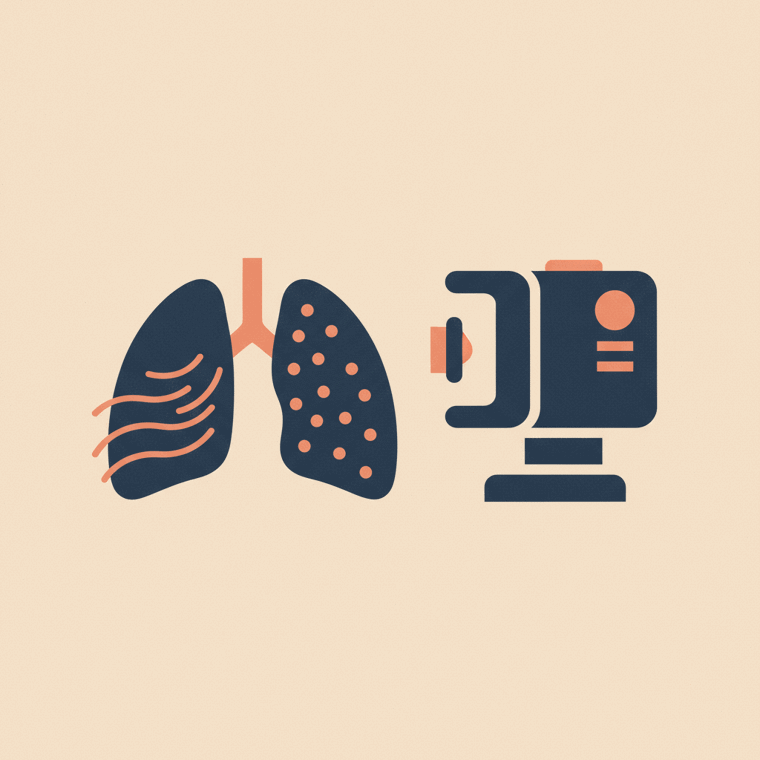
A VQ scan (ventilation/perfusion scan) is a nuclear medicine test that checks for a pulmonary embolism — a blood clot in the lungs. It compares air flow (ventilation) with blood flow (perfusion) in the lungs; a clot shows as an area getting air but not blood. It uses a small radioactive tracer and no iodine contrast, so it's often chosen in pregnancy or when someone can't have CT contrast — an alternative to a CTPA.
Key takeaways
- A VQ scan checks for a pulmonary embolism (lung clot).
- It compares air flow (V) with blood flow (Q) in the lungs.
- A clot shows as an area getting air but not blood.
- It uses no iodine contrast — often preferred in pregnancy or contrast allergy.
A VQ scan is a nuclear medicine test that, like a CTPA, checks for a blood clot on the lung — but it works in a completely different way, which makes it useful in specific situations.
What “VQ” means
VQ stands for ventilation (V) and perfusion (Q) — the two things the scan compares:[1]
- Ventilation — how air reaches different parts of the lungs. You breathe in a small amount of a radioactive gas or mist.
- Perfusion — how blood reaches different parts of the lungs. A small radioactive tracer is injected into a vein.
A gamma camera then maps both. A pulmonary embolism shows up as an area that is getting air but not blood — a “mismatch.”[1]
Why choose a VQ over a CTPA?
Both answer the same question. A VQ scan is often preferred when a CTPA’s contrast or radiation is a concern:[2]
- Pregnancy — a VQ (or a perfusion-only version) is frequently chosen to reduce dose to the breasts and baby.
- Iodine contrast allergy or reduced kidney function — a VQ uses no iodine contrast.
A CTPA is faster and more available out of hours, and also shows other chest problems — so the choice depends on your circumstances and what’s available.
What to expect
You breathe in the ventilation agent and have the perfusion tracer injected, then lie still while the camera takes pictures.[2] It’s painless, uses a small radiation dose, and the tracer clears over the following hours (drinking fluids helps). Tell the team if you are, or might be, pregnant or breastfeeding.
For the CT-based alternative, see our guide to the CTPA scan.
Frequently asked questions
What’s the difference between a VQ scan and a CTPA?
Both look for a lung clot. A CTPA is a CT with iodine contrast; a VQ scan is a nuclear medicine test comparing air and blood flow, using no iodine contrast — so it’s often chosen in pregnancy or contrast allergy.[1]
Is a VQ scan safe in pregnancy?
It’s often the preferred test in pregnancy because it can be done at a low dose and avoids iodine contrast. As always, tell the team you’re pregnant so they can tailor it.[2]
Does a VQ scan hurt?
No — you breathe in the ventilation agent and have a small injection for the perfusion part; the scan itself is painless.[2]
Sources
- RadiologyInfo.org (RSNA & ACR) — General Nuclear Medicine — www.radiologyinfo.org/en/info/gennuclear
- RANZCR / InsideRadiology — Nuclear medicine (Cain) — www.insideradiology.com.au/nuclear-medicine/
- healthdirect (Australia) — Pulmonary embolism — www.healthdirect.gov.au/pulmonary-embolism