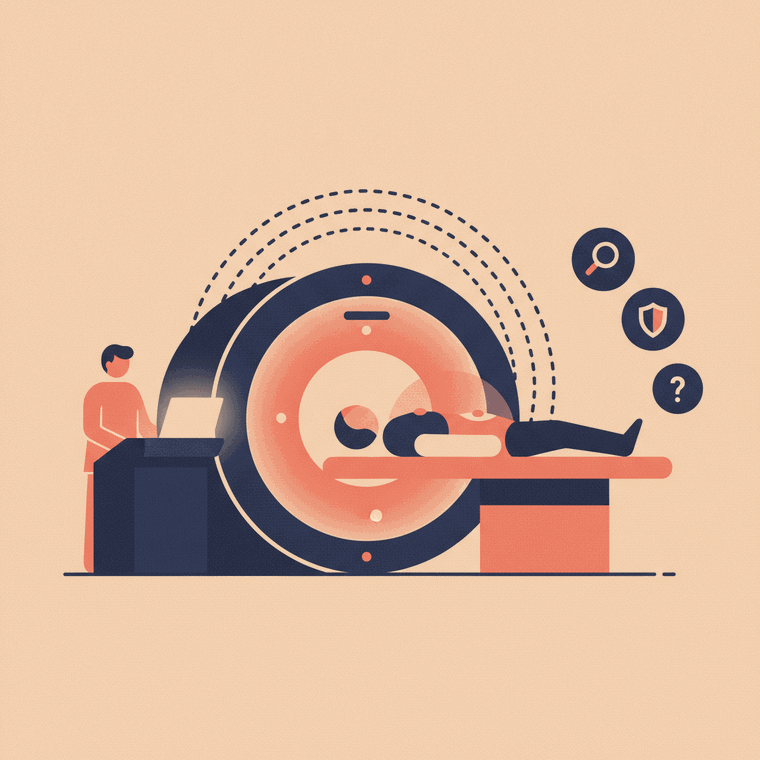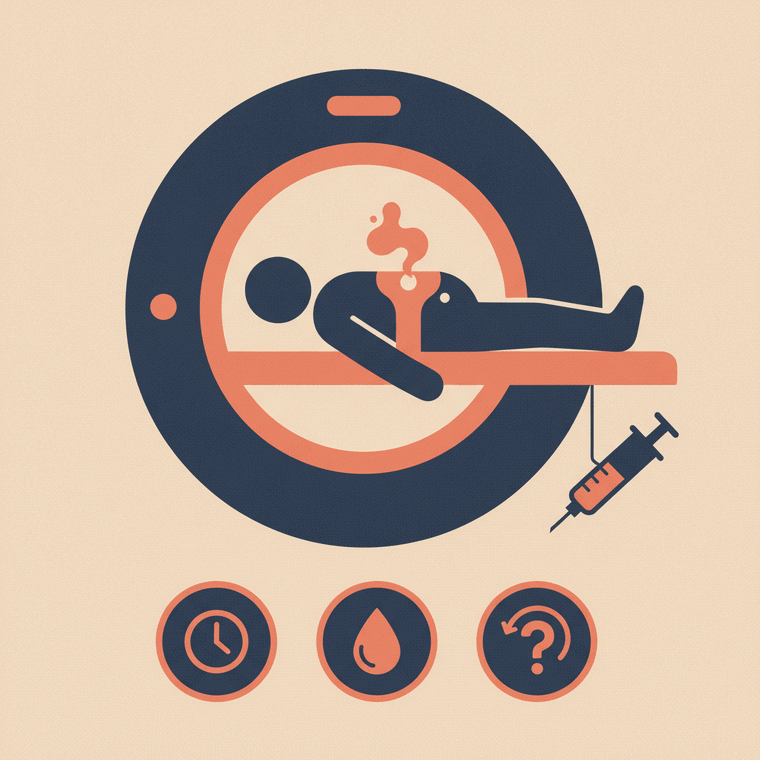
An abdominal (and pelvic) CT gives a detailed, cross-sectional look at your internal organs — the liver, kidneys, pancreas, bowel and more. It's used for unexplained abdominal pain, suspected appendicitis, kidney stones, cancer, and trauma. Many abdominal CTs use contrast — an injection, and sometimes a drink — so you'll often need to fast beforehand. It's the higher-dose CT (around 10 mSv, a few years of background radiation), used when the detailed view is genuinely needed.
Key takeaways
- It shows the abdominal and pelvic organs in cross-sectional detail.
- Common uses: abdominal pain, appendicitis, kidney stones, cancer, trauma.
- Often uses contrast (injection ± drink), so fasting is common.
- Higher dose than other CTs — about 10 mSv — used when justified.
The abdomen is packed with organs, and when something’s wrong there, a CT is often the quickest way to get a clear, detailed answer.
What an abdominal CT shows
A CT of the abdomen and pelvis produces detailed cross-sections of the liver, gallbladder and bile ducts, pancreas, spleen, kidneys, bladder, bowel and blood vessels.[1] Common reasons for one include:[1]
- Unexplained abdominal or pelvic pain
- Suspected appendicitis or diverticulitis
- Kidney stones (CT is very good at finding them)
- Detecting and staging cancers of the abdomen and pelvis
- Trauma — quickly checking for internal injuries and bleeding
- Investigating abnormal blood tests or other scan findings
Contrast and preparation
Many abdominal CTs use contrast to make organs and blood vessels stand out:[2]
- An intravenous injection (you may feel a warm flush and metallic taste)
- Sometimes an oral contrast drink, sipped over an hour or so, to outline the bowel
Because of the contrast, you’ll often be asked to fast for a few hours beforehand, and you may need a kidney blood test first. Tell staff about allergies, kidney problems, diabetes (especially metformin), and possible pregnancy. (See our full guide to preparing for a CT.)
The radiation
An abdominal/pelvic CT is one of the higher-dose CTs — around 10 mSv, roughly a few years of natural background radiation.[3] That’s why it’s used when the detailed view is genuinely needed, and why doctors sometimes choose ultrasound first for the abdomen (no radiation) when it can answer the question.
What to expect on the day
You lie on your back and the table moves you through the ring-shaped scanner; you may be asked to hold your breath briefly to keep the images sharp.[1] The scanning takes only a few minutes, though the whole appointment (with contrast) is usually within about 30 minutes. Afterwards you can resume normal activities; drinking water helps clear the contrast.[1]
Frequently asked questions
Do I need to fast before an abdominal CT?
Usually yes, if you’re having contrast — commonly a few hours of fasting. Your clinic will confirm, and will tell you if you also need a contrast drink beforehand.[2]
Why did my doctor order a CT instead of an ultrasound?
Both are used for the abdomen. Ultrasound (no radiation) is often first for things like gallstones. CT gives a more complete, detailed cross-section and is better for trauma, cancer staging and complex problems — so the choice depends on the question.[1]
Is the contrast injection safe?
For most people, yes. Mild effects (warmth, metallic taste) are common and brief; serious reactions are rare. Your kidneys are checked first if there’s any concern.[2]
Sources
- RadiologyInfo.org (RSNA & ACR) — CT of the Body — www.radiologyinfo.org/en/info/bodyct
- RANZCR / InsideRadiology — Iodine-containing contrast medium (ICCM) — www.insideradiology.com.au/iodine-containing-contrast-medium/
- ARPANSA — Medical imaging radiation doses — www.arpansa.gov.au/understanding-radiation/radiation-sources/more-radiation-sources/medical-imaging