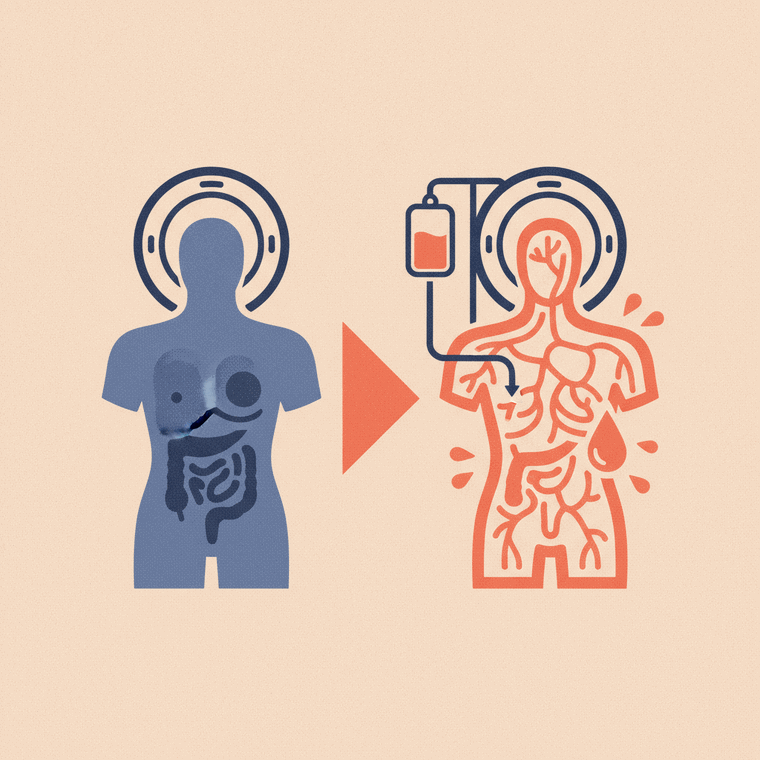
Contrast is a substance that makes blood vessels and certain organs show up clearly — it isn't radioactive and doesn't permanently stain anything. CT uses iodine contrast; MRI uses gadolinium. Many scans don't need any contrast — for example most plain X-rays, and many brain, spine and joint MRIs. Whether you need it depends on the clinical question, and your radiologist decides.
Key takeaways
- Contrast highlights blood vessels and certain organs to answer specific questions.
- CT uses iodine contrast; MRI uses gadolinium — they're different agents.
- Many scans need no contrast at all.
- The radiologist decides whether contrast will give the necessary information.
“Contrast” (sometimes called dye) is a substance that makes the inside of blood vessels and certain organs show up clearly on a scan.[1] It isn’t radioactive, and it doesn’t permanently colour your organs — it just changes, briefly, how the imaging sees certain tissues. Whether your scan uses it depends on what your doctor needs to see.
When contrast is used
The radiologist reads what your doctor wants to know and decides whether contrast will provide the necessary images.[2] It’s typically used to:[1]
- show blood vessels (for example in a CT angiogram);
- make organs or abnormal areas (like a tumour or area of inflammation) stand out;
- outline the bowel (a contrast you drink for some abdominal CTs).
Iodine vs gadolinium
The type of contrast depends on the scan:[2][3]
- CT (and X-ray/fluoroscopy) use iodine contrast — given by injection or sometimes as a drink.
- MRI uses gadolinium contrast — a different agent.
They have different precautions, so being able to have one tells you nothing about the other.
When no contrast is needed
Plenty of scans need no contrast at all — most plain X-rays, and many common MRIs (brain, spine, joints).[3] If contrast isn’t required to answer the question, it isn’t used. A non-contrast scan is often quicker and needs less preparation.
What to tell your team
If contrast might be used, tell staff about any allergies, asthma, kidney problems, diabetes, a previous reaction to contrast, or whether you could be pregnant — the precautions differ for iodine and gadolinium.[2][3]
Frequently asked questions
Will my scan use contrast?
It depends on the clinical question. Many scans don’t need it; your radiologist decides whether it will provide the necessary information.[2]
Is the dye for a CT the same as for an MRI?
No — CT uses iodine and MRI uses gadolinium. They’re different agents with different precautions.[3]
Does contrast add radiation to my scan?
No. Contrast agents aren’t radioactive. Any radiation in a CT comes from its X-rays, with or without contrast; MRI and ultrasound use no ionising radiation at all.[1]
Sources
- RadiologyInfo.org (RSNA & ACR) — Contrast Materials — www.radiologyinfo.org/en/info/safety-contrast
- RANZCR / InsideRadiology — Iodine-containing contrast medium (ICCM) — www.insideradiology.com.au/iodine-containing-contrast-medium/
- RANZCR / InsideRadiology — Magnetic resonance imaging (MRI) — www.insideradiology.com.au/mri-hp/