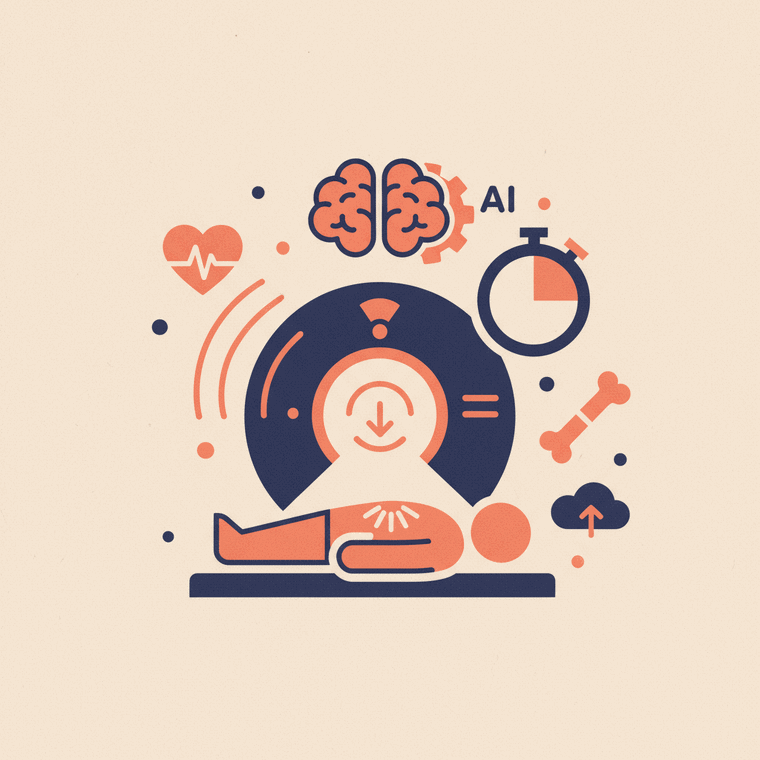
Medical imaging is evolving quickly. Artificial intelligence is increasingly used to help radiologists work faster and flag findings (it assists, rather than replaces, the specialist doctor). Scanners are getting faster and lower-dose, and radiation-free tests like MRI and ultrasound continue to expand. For patients, that broadly means quicker scans, lower radiation, and reports turned around faster.
Key takeaways
- AI increasingly assists radiologists — it supports, rather than replaces, the doctor.
- Modern scanners are faster and can deliver lower radiation doses.
- Radiation-free imaging (MRI, ultrasound) continues to expand in use.
- For patients this generally means quicker scans and faster reports.
Medical imaging has always moved with technology, and it’s changing quickly. Here’s a grounded look at where it’s heading — and what it means for you as a patient.
Artificial intelligence as an assistant
The most talked-about change is artificial intelligence (AI). AI tools are increasingly used to help with tasks like flagging possible findings, measuring structures, prioritising urgent scans, and reducing the noise in low-dose images.[1] The important point: these tools assist the radiologist — the specialist doctor still interprets the images and is responsible for the report. AI is a second set of eyes and a time-saver, not a replacement for clinical judgement.
Faster, lower-dose scanners
Hardware keeps improving. Newer CT scanners have better detectors and can significantly reduce the radiation dose, especially for children, while still producing clear images.[2] Scans are also getting faster, which means less time holding still and shorter appointments.
More radiation-free imaging
Because ultrasound and MRI use no ionising radiation, there’s a continued push to use them wherever they can answer the clinical question — particularly for children, in pregnancy, and where repeated monitoring is needed.[2] MRI techniques keep expanding into areas once dominated by radiation-based tests.
Faster access and reporting
Digital systems and teleradiology (where images are read remotely) help get scans reported sooner, including after hours and in regional Australia — so your doctor can get answers faster.
What it means for you
For patients, the broad direction is positive: quicker scans, lower radiation where radiation is used, more radiation-free options, and faster reports — all while a qualified radiologist remains the person interpreting your images.[1]
Frequently asked questions
Will AI replace radiologists?
No. Current AI tools assist radiologists — flagging findings and saving time — but the specialist doctor interprets the scan and is responsible for the report.[1]
Are newer scans lower in radiation?
Often, yes. Modern CT scanners can significantly reduce the dose while keeping image quality, and there’s a continued shift towards radiation-free tests where they’re suitable.[2]
Sources
- RANZCR — Artificial Intelligence (standards) — www.ranzcr.com/our-work/artificial-intelligence
- RANZCR / InsideRadiology — Radiation risk of medical imaging — www.insideradiology.com.au/radiation-risk/